
Brazil
30 Open Study/Research Award
Accepted Degree Levels
|
Grant PeriodSeptember StartGrant Length9 Months |
Award Type
Award Profile
The 2027–2028 awardees will stand out as Fulbright Brazil’s 70th cohort, a milestone in the bilateral academic exchange.
Proposals to conduct study and research in Brazil, either independently or as part of the candidate's current graduate program, will be considered. Affiliation with an academic institution and the presentation of a well-thought-out research plan are central to this type of project. All applicants are required to demonstrate the relevance of their projects to the Brazil Fulbright Program's mandate, which is to enhance mutual understanding between the United States and Brazil.
Applicants who will have received a Ph.D. by June 30, 2027, should apply to the Fulbright Scholar Program.
Grant Length
Grant Period
- Grant dates follow the U.S. academic calendar.
- For a nine-month grant, grant dates will be from September 2027 to June 2028
- Other start dates will not be considered.
- Candidates must attend the in-country arrival orientation.
Orientation
Mandatory.
All pre-departure orientation sessions will occur online between December and January prior to the grant start date. They cover:
- Visa application process with the Fulbright Commission staff
- Health and security briefings, with the U.S. Embassy in Brazil specialized officers
- Mental health care, with a Brazilian clinical psychologist specialized in cross-cultural issues
The grant starts with an in-country arrival orientation that lasts up to four days. After orientation, grantees head to their host cities.
Orientation takes place in São Paulo, Brazil. The Fulbright Commission provides accommodation, meals, and an allowance to help cover transportation to/from the airport for the orientation days.
Candidate Profile
The following attributes are very important in the selection of finalists for this award:
- Presenting a well-defined project proposal
- Demonstrating a solid working relationship with the proposed affiliate in the application
- Clearly outlining plans for engagement with the host community and
- Expressing the relevance of the proposed grant activities to the applicants’ plans.
We also consider the following competencies essential to succeed as a researcher in another country, and we suggest you reflect on them before putting your application together. You are welcome to provide examples of your competencies in your Statement of Grant Purpose and in the section Fulfilling the Fulbright Mission.
- Motivation and seriousness of purpose
- Ability to plan and carry out research
- Self-reliance and independence
- Potential for future growth in the chosen field
- Ability to communicate with people from various backgrounds
What is life like for Fulbrighters in the host country?
Applicants are expected to research their host country. Application materials should indicate a clear commitment to the host country community and a description of how you will engage with it.
Jesse Rocha
U.S. Student Study & Research 2022-23 at Fundação Armando Alvares Penteado, in São Paulo, Brazil.
Field of Study: Art History
Initially, Brazil overwhelmed me with its differences from home. I was in one of the biggest cities in the world, with a whole new language, culture, currency, and more. But once I took myself out of my comfort zone, I was amazed by the opportunities in front of me. Brazil offers a variety of low-cost benefits, including healthcare, cultural centers, and street festivals, meaning I always had chances to engage with the Brazilian lifestyle. Brazilians enjoy sharing their culture with newcomers, so I felt very welcomed into the country. This also extended into my research, as everyone from professors to artists themselves opened up their offices and even homes to help guide me. Exposure to Portuguese enabled me to read and write it better and more confidently than ever before. I ended my time in Brazil with a wide network of colleagues and friends and a stronger academic trajectory.
Daniel Gonzalez-Kosasky
U.S. Student Study & Research 2024-25
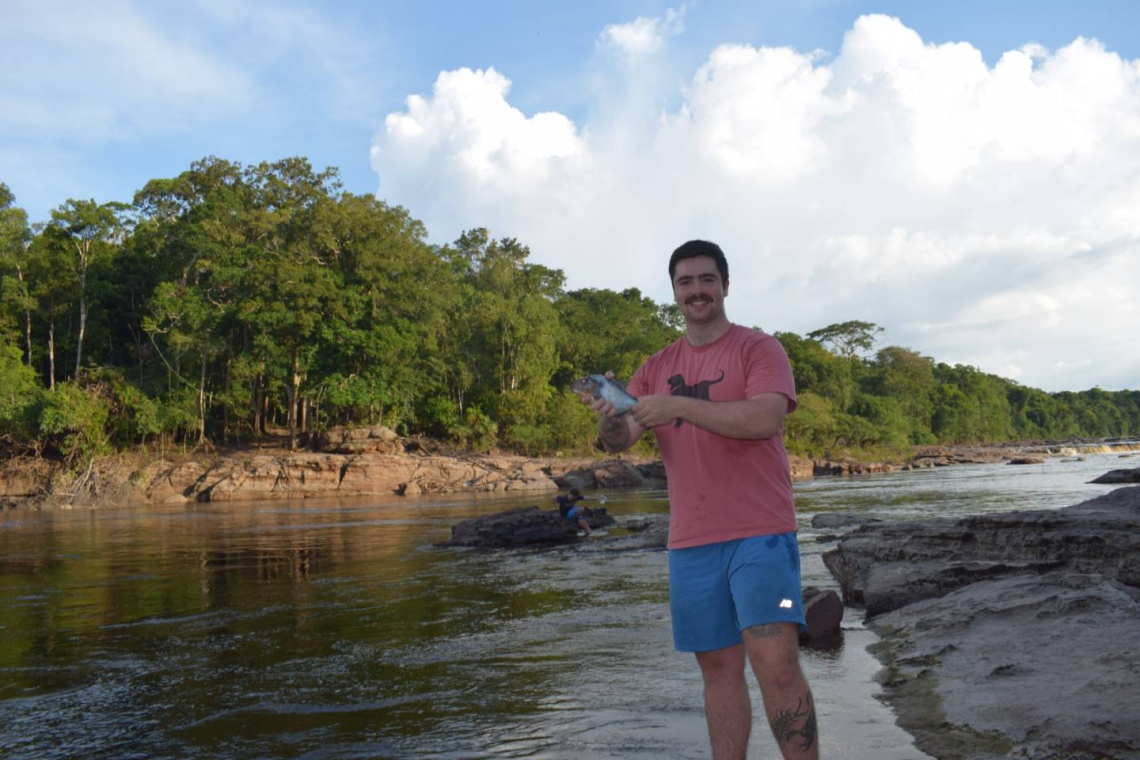
Project: Revising the taxonomy of Loricariidae from the Uruguay River Basin in Southern Brazil and Uruguay and identifying non taxonomically important morphological variance within Rineloricaria using molecular and morphological techniques.
My time in Brazil has been exhilarating, challenging, fun, but above all else, impactful. Aside from spending summers with family in El Salvador and a study abroad program in Australia as an undergraduate, I had never spent more than a week outside of the US. Thus, moving to Brazil for what would end up being about a year and a half was extremely out of my comfort zone. Ever since I was a child, I dreamed of being a biologist and studying freshwater tropical fish. While this dream has evolved during my time in high school and college as I learned more about research, my interests, and the fish themselves, the overall dream itself never changed. This led me to apply for a research Fulbright in Brazil even though I had never previously visited South America and spoke almost no Portuguese before arriving in Brazil. Despite receiving other research grants in the past and having an incredible support network of friends, family, and professors from undergrad, my time in Brazil has completely evolved my career goals, and forever changed the way I see myself and the world. Through the challenges of learning a new language, a new culture, and a new approach to research, I have grown substantially. My colleagues in Brazil are respected around the world and have directly led to me receiving so many relevant opportunities during and after my Fulbright to the point where I have had to deny most of them. I have never felt closer to achieving my lifelong dreams, for in a sense, completing my Fulbright allowed me to live my dream here in Brazil, while giving me the tools to never stop living it once I return to North America. Just as important as the opportunities and the unquantifiable personal growth I have experienced during my time In Brazil are the friends I have made during this journey. I already have numerous friends applying for and updating their visas to visit me in the United States with two having already bought their tickets, and I am not leaving Brazil for months! I am shocked at how much of a home I have been able to build here, and none of this would be possible without the Brazil Fulbright Commission taking a chance on me. It has been an honor and a privilege to be a Fulbright scholar and I cannot imagine reaching the point I have without this experience.
Eligibility
3 Months
Exceptions can be granted for short-term residency in the host country for formal language learning and for no more than three months in the 12 months prior to the start of the grant.
Degree Level of Applicant
- Bachelor's
- Master's
- Doctoral
Foreign Language Evaluation (FLE) Form
If required, submission of the Foreign Language Evaluation (FLE) form is mandatory, even if you have advanced skills or are a native speaker of the language. Failure to submit the required FLE form may impact your eligibility.
Level: Intermediate Portuguese - 2 years of college-level study or equivalent prior to commencing the grant OR Advanced Spanish - 3 years of college-level study in Spanish or the equivalent prior to commencing the grant, plus an additional study of Portuguese at the time of application.
Applicants who have begun the study of Portuguese at the time of application but have advanced Spanish skills must submit a Foreign Language Evaluation by a college-level language instructor in both Spanish and Portuguese with the application. A Foreign Language Evaluation by a college-level Portuguese language instructor is required for all applications.
Foreign Language Proficiency Level by Grant Start
If a Foreign Language Evaluation (FLE) form is Required, applicants must have the following proficiency level by the start of the grant period. If a Foreign Language Evaluation (FLE) form is Recommended, applicants are encouraged but not required to have the following level by the start of the grant period.
By the start of the grant, program participants will be expected to have at least an intermediate level of Portuguese. Portuguese language skills are necessary not only for the development of the proposed project but also for settling in easily and communicating on a daily basis. Weak or a lack of Portuguese proficiency will not harm an applicant's chances of being offered an award as long as they discuss their plans for language study between the time of application and the commencement of the grant via the Language Self-Evaluation form.
Fulbright Proposal Types
Yes
No
Affiliation
All applications must include a letter of affiliation. All candidates should state their host institution preferences in the application form.
All candidates must have an affiliation with an academic institution or research institute. Additional affiliations with non-profit organizations, archives, or governmental agencies are acceptable and may be desirable depending on the nature of the candidate's proposal. Final selection by the Fulbright Commission is subject to confirmation of an affiliation.
Graduating seniors and recent graduates must register as auditing students in at least one class per semester, preferably two, at the academic or research institution of affiliation. Registering for classes does not count for credit and does not entail paying tuition fees. Please contact your potential host professor or academic adviser to register for their classes or other classes of interest.
Candidates should not wait until near the application deadline to contact the Brazilian institution of their choice to obtain a letter of invitation. In contacting a potential Brazilian host, be aware that receiving a response can take longer than expected.
The letter of invitation can include the following:
- An indication that courses related to the applicant's interests will be available during the grant period (for graduating seniors and recent graduates only).
- Confirmation of the Brazilian institution's interest in hosting the candidate.
- Confirmation that the candidate will have access to the institution's facilities and services.
- Information about project feasibility regarding language skills, research clearance, and any further relevant information. Please see the Research Clearance section below for more details.
- Information on how the proposed project can impact ongoing activities in the Brazilian host institution.
- Information about a possible collaboration with or support from other organizations that are part of the host affiliate network.
The above list aims to help the applicant have conversations with potential affiliates. The Fulbright Commission does not require all the suggested items to be in the letter. While they can be helpful in the selection process, the lack of them will not damage the application.
Letters can be in Portuguese or English. If the invitation letter is in Portuguese, the applicant must include an English translation and the original letter with the application.
Research Clearance Instructions:
Candidates must discuss with their intended Brazilian affiliation how to apply for research clearance if their project plans require it. Projects needing research clearance may involve the following or similar:
- Research with human participants
- Research in protected areas
- Research involving secondary use of data
Please note that, in some cases, obtaining research clearance may take at least 10 months.
As a general recommendation, we strongly advise finalists to contact the host institution as soon as they are notified of their selection.
Affiliation Fees/Tuition
Award Benefits
- A stipend broadly based on the cost of living in the host country. These funds may be used by the grantee to support housing, meals, and incidental costs during the grant period.
- International travel benefits
- Accident & sickness health benefits
- 24/7 mental health support line for urgent and non-urgent situations
- 12 months of non-competitive eligibility (NCE) hiring status within the federal government
Stipend Amount
This is an estimated amount and is subject to change. The financial terms of the grant will be confirmed in the grant document issued after selection.
The Fulbright Commission pays a stipend in bulk of USD 3,060.00 every three months, with the first payment being made no later than 30 days before the grant start date.
One-Time Allowances
This is an estimated amount and is subject to change. The financial terms of the grant will be confirmed in the grant document issued after selection.
- Registration/Permitting fees
- Research/Materials allowance
- Settling in allowance
- Local transportation allowance
Below is the breakdown of the one-time allowances:
- Registration/permitting fees: USD $50
- Research allowance: USD $1,000
- Settling-in allowance: USD $1,020
- Local transportation allowance for the in-country arrival orientation: USD $50
Additional Grant Benefits
- Mid-year seminar
The Commission may organize a seminar at the end of the grant period for grantees to reconnect and present their research findings to the Commission and the Brazilian government funding agency.
Another benefit for Fulbright grantees in Brazil is a visa application fee waiver and a simplified visa application process.
Estimated Cost of Living
Consider using cost of living comparison websites to gain a better understanding of the potential costs in your host country.
Please visit this website to help estimate the cost of living, meals, and incidentals in different capital cities in Brazil. Significant differences can exist in smaller towns where costs tend to be lower.
Dependents
Housing Arrangements
The Commission does not offer housing or host family placements. Grantees are responsible for finding housing and making their arrangements. The Fulbright Commission can connect grantees with alumni who might provide helpful information about specific host cities.
Specific Considerations
Projects are encouraged in all parts of Brazil, not just in the main population centers. Specifically, priority will be given to applicants who locate their projects outside the urban areas of Sao Paulo, Salvador, and Rio de Janeiro. Be aware that competition for these urban areas is greater because of a proportionally more significant number of applications. Applications from all degree levels and in all fields of study are welcome.
If you would like to discuss your potential host city and possible host institution proposals or have any questions concerning the grant administration, don't hesitate to contact us. For application form-related questions, refer to the IIE Fulbright Application & Selection team.
The Brazilian government, through the Federal Agency for Support and Evaluation of Graduate Education (CAPES), co-sponsors this award.